
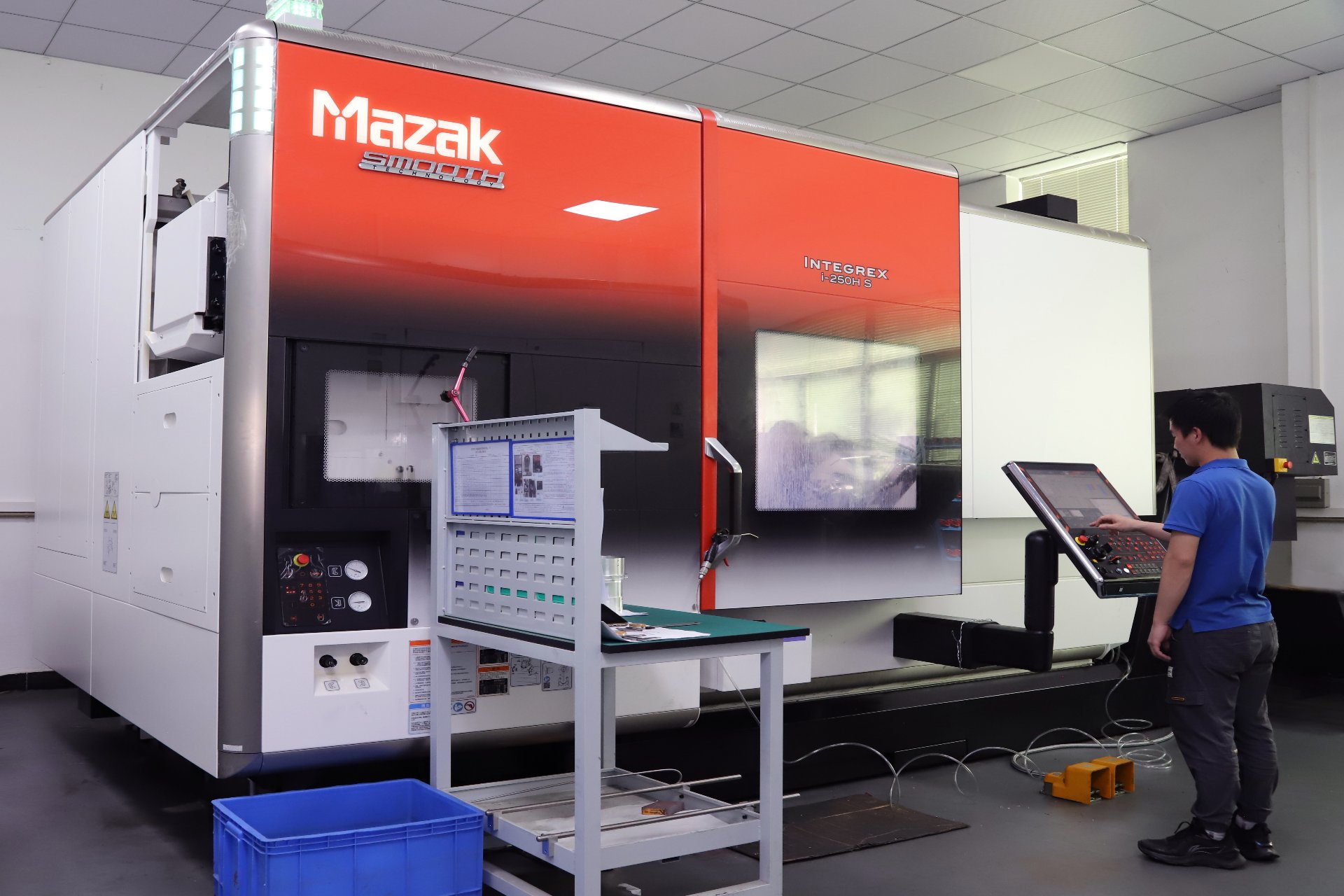
Every component drawing can be manufactured through more than one process chain, and the chain you pick decides the price, the lead time, the material properties, and how much of the tolerance risk you carry. A machining factory sits at one end of that choice: it starts from certified bar, plate, or billet and cuts the finished shape, which makes it the fastest route to a precision result. Casting, forging, metal injection molding, sheet fabrication, and additive processes all start the part closer to its final form and defer the precise work to a later machining step. The purpose of this guide is to compare those routes honestly against a full machining factory, feature by feature, so the route you choose follows the geometry and the drawing rather than habit.
What routes are you actually choosing between when you send a drawing out?
Lay the options side by side before comparing any prices. Machining from solid stock means milling and turning centers remove material to reach the final envelope; it needs no dies or molds, so the first part can be cut almost as soon as stock is ordered. Die casting shoots molten aluminum or zinc into a steel die for housings and covers at high rates, while investment casting builds a wax pattern and a ceramic shell for more complex or higher-alloy parts. Forging hammers or presses heated metal into a die to reorganize the grain structure along the part's load paths. Metal injection molding presses a powder-and-binder mixture into a mold, then sinters it, for very large quantities of small intricate metal pieces. Sheet metal fabrication laser-cuts and bends flat stock for panels, brackets, and enclosures. Additive manufacturing deposits material layer by layer to reach internal geometry that no cutter can access. Electrical discharge machining, usually called EDM, is not a competitor to cutting at all but a finishing family that machines features by controlled spark erosion.
| Route | Typical starting point | Where it shines | Precision as-formed |
|---|---|---|---|
| Machining from stock | Certified bar, plate, billet | Low tooling, fast start, tightest tolerances | Yes, by cutting process |
| Die / investment casting | Molten alloy into die or shell | Complex near-net form at volume | No — finish machining follows |
| Forging | Heated billet pressed in die | Worked grain flow for fatigue | No — critical faces machined after |
| Metal injection molding | Powder plus binder, sintered | Small complex parts at high volume | No — sintered band is loose |
| Sheet fabrication | Flat sheet, laser cut and bent | Plate-like parts at low cost | No — precision features machined |
| Additive manufacturing | Powder or wire, layer by layer | Unreachable internal geometry | No — surface and tolerance need cutting |
Notice what the table says about precision: with one exception, every non-machined route delivers its part in a form tolerance that is looser than a machined drawing, so the critical bores, faces, threads, and finishes still end up on a cutting machine before the part ships. The real decision is therefore not between machining and something else. It is between machining the whole component from standard stock and machining the finishing operations of a component that started life in a die, a mold, a press, or a print bed.
Why does the tolerance band on the drawing steer the route choice so hard?
Read the drawing before you read the price list, and read the tight callouts first. A general-tolerance part can survive a cast, bent, or printed surface because nothing about the design depends on a controlled dimension. The moment the drawing carries a bore at ±0.003 mm, a true position callout, a thread class, or a specified finish, the process that produces that feature has already been named: it is a machining operation, and usually a finishing one at that. Casting, molding, and printing hold their own, much looser, as-formed bands; they do not hold machined bands.
That is why a machining factory positions the comparison correctly. It is not claiming that every part must be hogged from a solid block. It is stating that wherever the drawing is tight, the machining appears somewhere in the chain, and the practical question is who controls it. When the forming process and the finishing machining live under one roof, the datum chain, the inspection, and the tolerance arguments stay inside one accountable relationship. When they are split across a foundry here and a job shop there, each hand-off is a place where the tolerance story can break and where the schedule can quietly grow.
When should a part simply run from bar or billet in a machining factory?
Machining straight from stock wins on four conditions, and most orders satisfy at least two of them. First, the quantity is low or moderate, so there is no tooling to amortize and the unit cost of a machined part is acceptable. Second, the geometry is essentially solid — a shaft, a flange, a block, a fitting — so the material removed is a minority of the stock rather than most of it. Third, the lead time is short, because ordering certified bar and cutting it is the fastest start any route offers; there is no die to cut, no pattern to build, and no first-shot qualification. Fourth, the drawing is tight, because the tighter the callouts the more the whole route leans on machining anyway.
The economic edge of the stock route is easiest to see in the waste column. A bracket that is most of a block is a good machined part; the same bracket cut from a thick plate is fine too; but a hollow housing that leaves ninety percent of the billet in the chip bin is a part asking to be cast. When the geometry fits within a reasonable bar or plate envelope, machining from stock is usually the cheapest route at quantities up to a few thousand pieces, and it is always the fastest to the first article. It also carries the simplest material story: a mill certificate on a standard grade is easier to trace than the certification of a cast lot, a forged blank, or a sintered powder.
When does casting plus finish machining beat starting from solid?
Casting earns its keep on parts that are mostly empty space. Think of a pump housing with internal passages and thin walls, or an electronic enclosure with bosses and ribs: machining that shape from a billet would spend most of the material and a great deal of spindle time becoming chips, while a die or an investment shell delivers the same envelope near-net in one forming operation. Aluminum die casting is the volume workhorse for housings; investment casting handles geometries and alloys that die casting cannot, at a higher cost per part and a slower cycle.
The conditions that make casting the right answer are quantity and control. The die, the pattern, or the shell tooling is a real cost, so the run must be large enough to amortize it. The casting source must be controlled well enough that porosity, inclusions, and shrinkage do not wander into the finish-machined surfaces, because a void revealed under a reamed bore is scrap that the machining step cannot save. And the critical features are still machined after the cast — the parting line is not a datum and an as-cast surface is not a controlled surface. Compare casting plus finishing at your real quantity, not the two quotes you get when you ask one side of the chain only.
When is forging chosen for material properties rather than shape?
Forging is selected for a reason that has nothing to do with price per kilogram: it reorganizes the grain of the metal along the shape of the part. A forged connecting rod, a forged fitting, or a forged landing-gear bracket carries grain flow that follows the load path, and that worked structure is what gives the part its fatigue life in high-cycle service. A part machined from bar keeps the grain running straight along the stock, regardless of where the stresses concentrate, which is why specifications in aerospace, energy, and heavy equipment frequently require the forged condition outright.
Where the specification does not demand forging, the economics usually do not favor it. Forged blanks need dies and a forging source with its own qualification, and the blank arrives near-net with scale and draft angles that still have to be machined away on the functional surfaces. So forging is typically the right answer when the drawing or the governing standard names it, and the precision machining follows at the end of the chain. A factory that sources qualified forging blanks and runs the finish machining in-house keeps the hand-offs short; a buyer who manages a forge and a machine shop separately carries the tolerance and delivery risk between them.
Where does metal injection molding fit for small parts at real volume?
Metal injection molding is the volume specialist among the forming processes. Fine metal powder is mixed with a binder, the mixture is injected into a mold like plastic, the binder is removed, and the remaining metal is sintered into a solid part. The process reaches small internal features, thin walls, and complex contours that would be slow or impossible to machine economically, and at volumes in the tens of thousands it can undercut machining on unit cost for the right geometry.
Two constraints keep MIM honest in a comparison. The first is the material story: a sintered part is not identical to a wrought bar of the same grade, and the specification must either accept the sintered microstructure or rule the process out. Density, ductility, and mechanical properties differ from wrought stock, so the engineer should sign off on the material condition before the mold is cut. The second is precision: the as-sintered tolerance is a molding tolerance, not a machined one, so tapped holes, reamed bores, and close mating faces are finished by machining after sintering. The MIM quote that looks cheap on the unit line can hide the finishing operations that a careful buyer adds back.
When do sheet fabrication, additive, and EDM belong on the route?
Sheet fabrication competes wherever the part is essentially flat. A mounting plate, a cover, an enclosure panel, or a bracket with simple bends can be laser-cut and folded for a fraction of the cost of cutting the same envelope from solid, and the gap widens as the quantity climbs. The tolerance of the cut and bent part is looser than machining, so the design must tolerate it, and any locating bore, mating face, or threaded pattern that has to align stays on a machine afterwards. The common pattern is hybrid: the flat body is fabricated, the precise features are machined, and the best outcome is a supplier that manages both so the interface is designed rather than discovered.
Additive manufacturing earns its place when the geometry is genuinely unreachable — an internal conformal cooling channel, a lattice, a one-piece manifold replacing an assembly of machined parts — or when a single prototype must exist before any tooling decision. Everywhere else it loses the comparison on the axes a precision drawing cares about: surface finish that still needs cutting, dimensional stability that depends on the build and its heat treatment, a material certificate that is more complicated than a mill certificate, and a per-part cost that stays high. EDM, by contrast, is the finishing answer inside a machining factory: wire EDM cuts sharp internal corners and hardened material, and sinker EDM forms cavities a cutter cannot reach, with the EDM feature held to the machined datum by the same quality system.
How should you compare quotes that arrive from different process routes?
Different routes produce quotes that look nothing alike, and the way to compare them is to normalize every one to the same basis: total cost per delivered part at your real annual quantity. The machined-from-stock quote carries material waste but no tooling. The casting, forging, MIM, or fabricated quote carries tooling to amortize, secondary machining that may or may not be itemized, and a longer start because the tooling has to exist before the first part. Add the lead-time axis, because a die or mold program begins with weeks of toolmaking, while a stock program begins when the bar is ordered. Add the certification axis, because a mill certificate on standard stock is a simpler quality story than the material release of a cast or forged lot.
Then ask every supplier to name the route in writing: the starting material and its form, the certificate that comes with it, and the operations that produce the critical features, including how each is measured. A quote that says "CNC machined from 6061-T6 bar" and a quote that says "die cast A380, machined on critical faces" are different products wearing similar prices, and the cheaper-looking one may simply be hiding the finishing stage. Send the drawing with the annual quantity, the governing material specification, and the target date, and ask which route the supplier recommends and why. A factory that does this comparison daily will separate the parts that genuinely belong in a die or a mold from the parts that are cheaper and faster machined from stock.
Frequently Asked Questions
When is machining from bar better than casting or forging for a part?
Machining from bar is better when the quantity is low or moderate, the geometry is mostly solid and fits inside stock, the start needs to be fast, and the drawing carries tight callouts. Casting and forging earn their tooling when volume is high enough to amortize it and the part's form or properties justify the extra process.
Can cast, forged, molded, or printed parts hold ±0.003 mm as formed?
No. Those processes hold their own form tolerances in bands far looser than machining, and they reach tight bands only after finish machining of the critical features. A near-net route almost always ends on a cutting machine before the part can meet a machined callout.
What does a full machining factory offer that a single-process shop does not?
A full factory keeps turning, milling, grinding, and inspection under one quality system, so a part that needs several operations is routed internally and the datum chain is held in one inspection loop. A specialist may quote a lower unit price on its single process, but you carry the coordination, hand-offs, and tolerance risk between vendors.
Which route gets to the first article fastest?
Machining from standard bar or plate is the fastest start because there is no tooling to build and no process qualification before the first part. Casting, forging, MIM, and printed routes all add a forming step ahead of the machining, which lengthens the path to the first approved piece.
How do the tolerance bands compare across the routes in this guide?
Milling and turning hold ±0.003 mm with capability at Ppk ≥ 1.67 at the initial study on key characteristics and Cpk ≥ 1.33 on general characteristics. Capability is reported per characteristic: every report names the feature, its tolerance band, the sample size, the sigma method, and the study window., and precision grinding reaches ±0.002 mm. Die casting, forging, MIM, fabrication, and additive deliver their own, looser, as-formed geometry and reach tight bands only through finish machining.
Is EDM a replacement for CNC machining?
No — EDM is a finishing process that works inside a machining route. Wire EDM cuts sharp corners, deep narrow slots, and hardened material, and sinker EDM forms cavities that cutters cannot reach, but the parts that need EDM are usually machined first and the EDM feature is held to the machined datum.
What should I send to get route comparisons I can trust?
Send the final-revision drawing, the material specification with condition and form, the annual quantity, and the target date, and ask each supplier to name the route in the quote — the starting material, the certificate, and which features are machined and measured. That makes the quotes comparable and the hidden stages visible.
Unsure whether your part should start from bar, a die, or a print bed?
Send the drawing and the annual quantity through the factory contact page and the process review will name the route it recommends, the material certificate behind it, and the features that will be machined and measured, so you can compare alternatives on equal terms.