
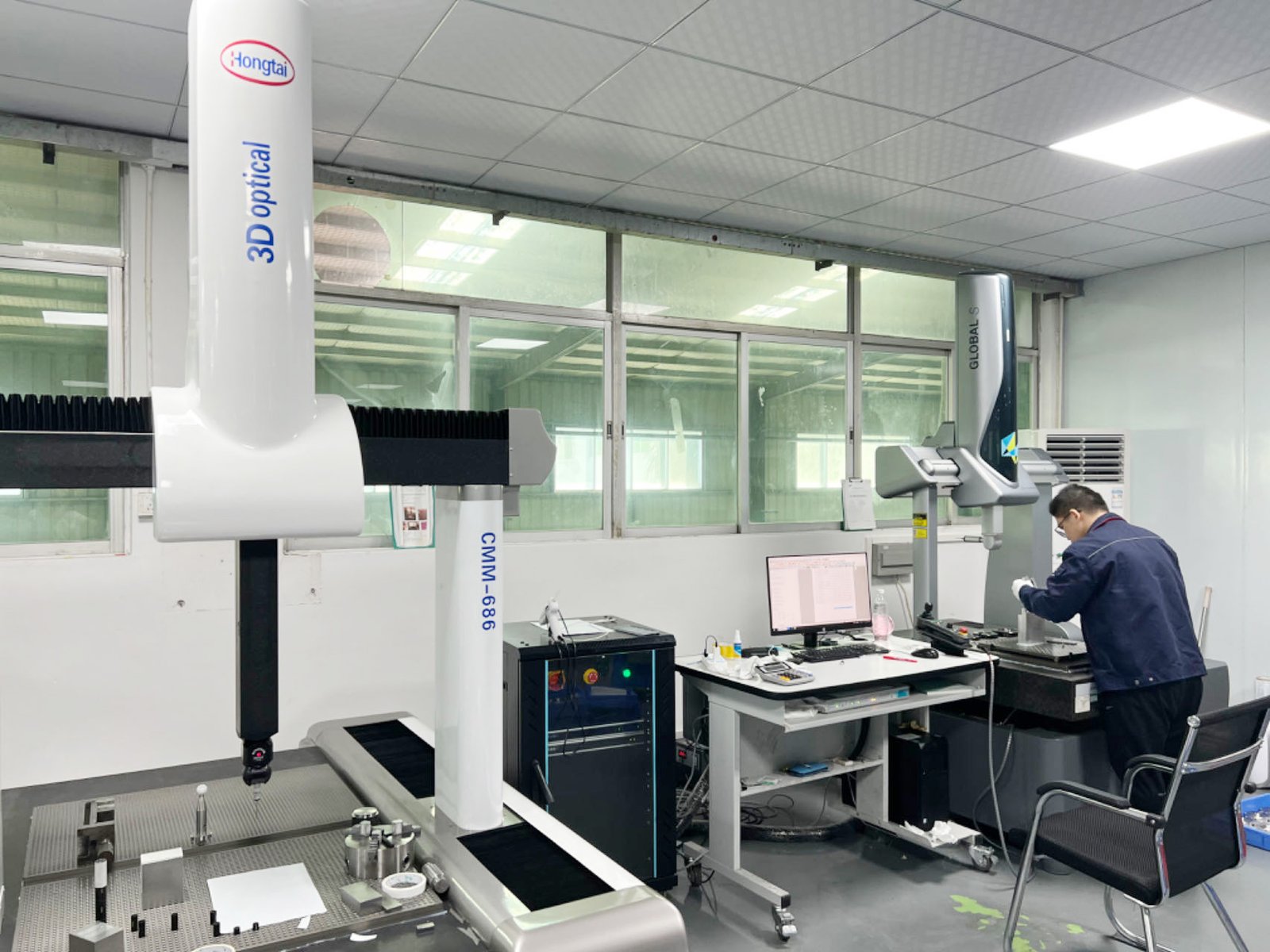
A machining factory prices its work from its own floor: the material it buys, the hours its machines run, the tools they consume, the people who operate them, and the overhead that keeps the lights on. When a buyer works directly with that factory, the quote carries one margin instead of several, and the price reflects the physics of the part rather than the layers of the supply chain. Understanding how a factory builds its number is the shortest route to reading it correctly.
The anatomy is consistent across factories even when the numbers are not. Material, machine hours, setup and programming, finishing, inspection, and freight each contribute to the total, and their proportions shift with the part. A buyer who can estimate each line from the drawing can judge any quote, catch the assumptions that inflate it, and know which design changes will reduce it.
1. How does a factory turn a drawing into a price?
The factory starts by reading the drawing for the three things that set the process: the material, the geometry, and the tolerances. The material names the stock and the cutting behavior; the geometry names the operations and the setups; the tolerances name the machining care and the inspection depth. From those three readings the factory builds a process route across the machining services, and the route becomes the price.
The route is the invisible structure of every quote. It lists the stock to buy, the machines to use, the order of the operations, the outside processes, and the inspection steps. Two factories with identical rates can quote different totals because their routes differ - one holds the material and cuts the part in a single setup, another buys the stock and sends a feature outside. Comparing routes is comparing the real content of the price.
This is why the itemized quote matters more than the total. Ask for the material line, the machine time, the setup allowance, the finishing, and the inspection shown separately. A factory that itemizes is showing you its route; a factory that quotes a single number is asking you to trust a process you cannot see.
2. What determines the material line on a machined part?
The material line is the cost of the stock that enters the machine, not the cost of the metal in the finished part. When a component is machined from a solid block, the block is the purchased unit, and everything that is cut away is material the buyer has paid for and will not receive. The ratio of bought stock to finished part is the material utilization, and it sets the size of this line.
The grade and the section set the price per unit and the sourcing behavior. Common alloys in standard bar and plate sizes are inexpensive and stocked locally; special grades, large sections, and certified lots carry premiums and longer lead times. Where the design can accept a standard section or a slightly different grade, the material line moves down without changing the function of the part.
Near-net starting points change the material economics altogether. A hollow part cut from bar wastes the core; the same part from tube buys less material. A high-volume part machined from a forging or an extrusion starts close to the final shape and wastes almost nothing. The starting form is a design decision with a material line attached, and it is worth reviewing on every part that uses expensive stock.
3. How do machine hours translate into the quote?
The machine line is the cutting time at the machine's rate, and the rate covers the machine, the operator, the tooling consumed, and the floor space. A standard three-axis center rates lower than a five-axis machine, and a turning center rates differently from a mill. The hours are set by the geometry and the material, while the rate is set by the machine class and the market.
The buyer's leverage on this line is the hours, not the rate. Geometry that keeps features reachable in one setup reduces hours. Walls thick enough to cut aggressively, corners accessible to the tool, and features that do not force slow passes all reduce the cycle. A part designed for machining costs less machine time than an identical function arranged awkwardly, and that difference lands directly in the quote.
Ask the factory for the estimated cycle time per part. Dividing the machine line by the quantity reveals the hours behind the number, and comparing those hours across suppliers exposes who has planned a more efficient route. The supplier with the better plan is selling you fewer hours at the same rate - which is the same thing as a lower price.
4. Why do small orders carry a heavy fixed-cost load?
Every order carries fixed work that happens once regardless of quantity: the programming, the setup, and the prove-out of the first article. On a small order this fixed work spreads across few parts, so each part carries a large share. On a large order the same work spreads across many parts and the share shrinks toward nothing. The fixed costs are why the per-unit price falls so steeply at the start of the quantity curve.
The prove-out is the fixed cost buyers least expect. The first article is cut, measured, and often adjusted before the balance of the batch is released, and that cycle consumes machine and inspection time that no later part repeats. On a genuinely new part the prove-out can rival the setup in cost, which is why the first order of a design is always the most expensive.
The commercial terms around fixed costs matter as much as their size. Ask what the factory charges for a repeat order of the same part, because the repeat should carry neither the programming nor the prove-out. A factory that quotes repeats at nearly the first-order price is charging you for engineering it will not perform again.
5. How much does precision add to a machining price?
Precision adds cost through the process it demands and the evidence it requires. Holding a feature at ±0.003 mm in milling and turning, or ±0.002 mm in grinding with capability targets such as Ppk ≥ 1.67 at the initial study on key characteristics and Cpk ≥ 1.33 on general characteristics. Capability is reported per characteristic: every report names the feature, its tolerance band, the sample size, the sigma method, and the study window under the quality system, needs controlled feeds, stable setups, careful tooling, and measurement on the actual part. The controlled feeds lengthen the cycle; the measurement lengthens the inspection; both appear in the quote.
The cost scales with the number of controlled features, not just their tightness. One critical bore on a housing adds a modest line; a drawing where every dimension is controlled leaves no room for the process to drift and multiplies the inspection. Tolerance density is a cost that compounds, which is why concentrating the criticals where they function is the highest-value cost move on a precision drawing.
The material decides how expensive the precision is to hold. Aluminum reaches a tight band with a good setup; stainless and the hard alloys need more care, sharper tools, and sometimes a finishing pass with fresh tooling. When a critical callout sits in a demanding material, expect the tolerance line of the quote to carry a larger share of the total.
6. Where does finishing fit in the factory price?
Finishing is the line where factory quotes diverge most, because the process behind the words varies. As-machined parts carry no finishing line. Bead blasting adds a modest step. Anodizing spans a wide cost range from clear to hard with verification, and plating and specialized coatings sit higher still. The factory prices the process it intends to run, and different factories intend different processes for the same vague callout.
The way to stabilize this line is to name the finish on the drawing as a process or a value. A drawing that says bead blasted, clear anodize, or Ra 0.8 produces comparable quotes; a drawing that says smooth or standard invites each factory to choose its own process and price it differently. The finish spec is a cost control device as much as an engineering one.
The cheapest finish is the one the part does not need. A component that will be tested for corrosion or wear earns the engineering finish and its cost. A component that only needs to look presentable runs bead blasted or as-machined. Reviewing the finish against the application removes a recurring cost from every order of the part.
Batch economics also shape the finishing line. Tanks and coating lines run on cycles and minimum batch sizes, so a small order may pay for a full batch slot or wait for other work to fill it. Asking how the factory batches finishing, and whether your quantity can share a cycle with a scheduled run, can move the finish line more than any finish-to-finish price comparison.
7. How do you compare factory quotes without comparing apples to oranges?
Comparison starts with normalization. Put the identical drawing, material grade and section, finish, quantity, and trade terms in front of each factory, and ask each for the same itemization. A quote on a cheaper material, a simpler finish, or different terms is not comparable to anything, and comparing unnormalized quotes is how buyers pick the wrong supplier with confidence.
The second normalization is the freight boundary. A factory quoting delivered prices folds the freight, duty, and handling into the total; one quoting ex-works leaves them for you to add. Compute every quote to the same delivered boundary before comparing, and remember that the slow freight mode carries an inventory cost that belongs in the comparison as well.
The final comparison is the route and the assumptions behind the lines. A quote whose material line matches the market, whose machine hours fit the geometry, and whose finish line matches the drawing is credible even when the total surprises you. A quote whose lines do not reconcile with the drawing is a quote built on assumptions - and the assumptions will surface later as change orders.
8. How do you use the factory view to drive the price down?
Use the itemized quote to attack the lines, not the total. Where the material line is high, review the section and the grade. Where the machine line is high, review the geometry for setups and features that force slow passes. Where the finishing line is high, review whether the process is functional. Each line responds to a different design lever, and the levers are all free on paper.
Quantity is the second lever. The fixed costs of programming, setup, and prove-out amortize with quantity, so committing to a repeat schedule or a larger batch moves the unit price more than any negotiation on the variable lines. Where the demand is real, a forecast that lets the factory plan the material and the capacity earns a better price than an order that arrives in isolation.
The third lever is the relationship itself. A factory that sees a steady stream of work prices its capacity around it, holds material against it, and invests in the tooling and the process for your parts. Buyers who feed the factory a predictable pipeline buy at the factory's best price; buyers who arrive with one-off orders pay for the factory's caution. In machining, the relationship is a line in the price whether the invoice shows it or not.
Frequently Asked Questions
What does factory price mean when applied to CNC machining?
It means the quote is built from the machine shop's own costs - material, machine hours, tooling, labor, and overhead - with one margin, rather than from a reseller's marked-up version of the same costs. The word is a structural claim about the supply chain, and it is worth verifying by asking where the machines are and who operates them.
Why does the same part cost different amounts at different quantities?
Because part of the price is fixed - programming, setup, and prove-out happen once per order - and part is variable - material and machine time scale with each piece. At small quantities the fixed costs dominate the unit price; as quantity rises they amortize and the unit price falls toward the variable cost. The curve is steep at first and flattens quickly.
What is the single biggest waste in a machining quote?
Buying material that becomes chips. When a part is cut from a solid block, most of the purchased stock is machined away, and the buyer pays for the whole blank. Reducing the blank to the smallest section that works, or starting from a near-net form, removes that waste directly from the material line.
How much does a tight tolerance add to the unit cost?
A precision callout adds machining care and inspection time to every part it touches. The cost grows with the number of controlled features and the difficulty of holding them in the material. A tolerance that serves no function is pure cost; a tolerance on a real mating feature is a legitimate line in the quote.
Is buying directly from a factory always cheaper than using an intermediary?
Usually on the machining itself, because the intermediary layers its margin, its overhead, and its freight handling over the factory's price. The factory-direct quote can lose that advantage if the buyer must manage the relationship, the quality, and the logistics that the intermediary was providing. The comparison is total cost, not just the price line.
Why do finishing prices vary so much between suppliers?
Because finishing is where processes diverge. Clear anodize, hard anodize, passivation, electropolishing, and plating each have different costs, and suppliers often quote different processes for the same vague finish callout. Naming the finish as a process or a measured value removes the variance from the comparison.
What should a buyer check before trusting a low machining quote?
The scope behind the number. Confirm the material grade and section, the finishing process, the inspection documentation, and the trade terms are what the drawing requires. A low quote built on a cheaper material, a simpler finish, or a skipped inspection step is not a bargain; it is a future change order.
How do you estimate a machining budget before receiving a quote?
Build it from the physics. Estimate the part volume for material, estimate the machine minutes from the geometry and material, add a setup allowance for the quantity, add the finishing and inspection, and apply market rates. The estimate will not match the quote exactly, but it will tell you whether the quote is in the right country.
Want the route and the lines behind the number?
Send the drawing to [email protected] with the material and quantity, and ask for the itemized factory quote with the cycle time per part.